4-Week At-Home Workout Plan: Minimal Gear + Daily Stretch
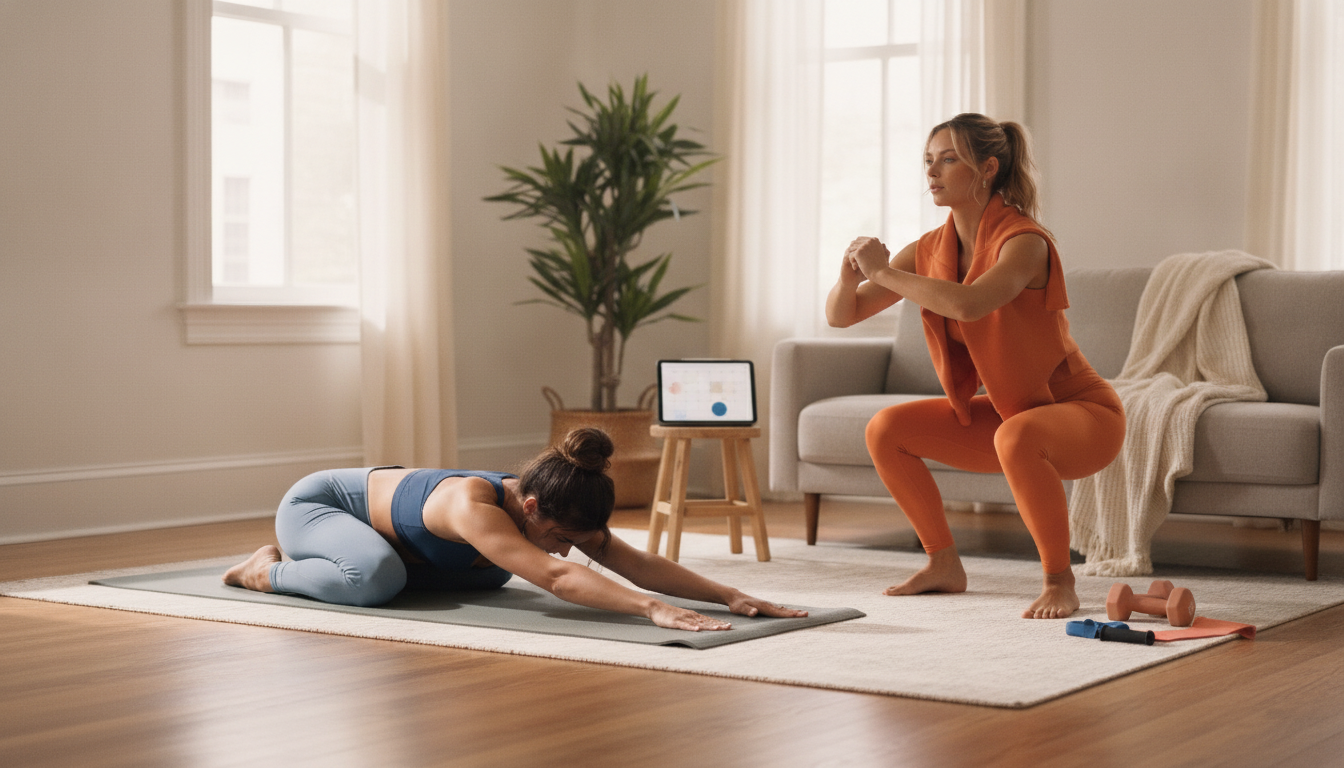
Fit at Home: A 4-Week Minimal-Equipment Workout Plan with Daily Workouts and Stretches
A structured 4-week home routine can remove guesswork by pairing simple strength and cardio sessions with daily mobility and stretching. This plan is built for small spaces, minimal gear, and steady progression across four weeks—so you can train consistently without needing a full gym setup.
What the 4-week plan is designed to do
This month-long layout aims to create a repeatable rhythm you can stick with. Each day has a clear purpose, so you’re not wondering what to do next—or skipping sessions because planning feels like another task.
- Build a consistent weekly rhythm with clear daily sessions (workouts plus stretches).
- Develop full-body strength using bodyweight and a small set of optional equipment.
- Improve conditioning through short, repeatable circuits that fit busy schedules.
- Support flexibility and recovery with guided mobility and post-workout stretching.
For general health, national guidance supports mixing aerobic activity with muscle-strengthening work during the week. If you want the “why” behind the basics, see the Physical Activity Guidelines for Americans and the CDC overview of physical activity benefits.
Who it fits best (and how to adapt it)
Home programs work best when they’re flexible. Use these adjustments to match your current fitness level and your space.
- Beginners returning to exercise: start with easier variations, longer rest, and fewer rounds.
- Intermediate exercisers: increase rounds, reduce rest, and add light resistance where available.
- People with limited space: choose stationary movements (marches, step-backs, floor-based strength).
- Time-crunched schedules: use the shortest session option on busy days and prioritize the daily stretch.
A simple rule: keep your form crisp and your breathing controllable. When technique slips, scale the movement before pushing intensity.
Minimal equipment checklist (optional upgrades)
You can complete the entire four weeks with bodyweight only. If you want extra variety or smoother progression, a few small add-ons go a long way.
- No-equipment essentials: supportive shoes (optional), a yoga mat or towel, a sturdy chair or couch edge.
- Helpful add-ons: light-to-moderate dumbbells or a kettlebell, resistance bands, a jump rope (space permitting).
- Household substitutes: backpack with books for load, water jugs for carries, towel for sliders on smooth floors.
- Comfort and consistency: a timer, water bottle, and a notebook or app for tracking reps and rounds.
Equipment options by training goal
| Goal | No-Equipment Option | Minimal Gear Option |
|---|---|---|
| Lower-body strength | Squats, split squats, glute bridges | Dumbbell/kettlebell goblet squat, band walks |
| Upper-body strength | Incline push-ups, pike push-ups, chair dips | Band rows, dumbbell presses |
| Core stability | Dead bugs, planks, side planks | Weighted carries, banded Pallof press |
| Conditioning | Marching intervals, step-ups, squat-to-stand | Jump rope, light dumbbell complexes |
How the 4 weeks typically progress
Progress doesn’t have to be complicated. This plan uses a simple month-long ramp that keeps you moving forward while protecting joints and recovery.
- Week 1: technique and baseline volume—focus on form, controlled tempos, and manageable effort.
- Week 2: density—slightly more work in the same time (extra round or reduced rest).
- Week 3: intensity—harder variations or added resistance while maintaining clean movement quality.
- Week 4: consolidation—repeat best sessions, aim for consistency, and retest a few benchmark workouts.
If you enjoy the “science of progression,” a classic reference is the ACSM progression model position stand, which supports gradual changes like adding reps, load, or reducing rest over time.
Sample weekly schedule (daily workouts + stretches)
Use this as a template for how the days fit together. Strength work alternates focus so muscles recover, conditioning stays short and repeatable, and mobility shows up daily to help you feel better session to session.
| Day | Workout focus | Stretch & mobility focus |
|---|---|---|
| Day 1 | Full-body strength circuit | Hips + thoracic spine |
| Day 2 | Low-impact conditioning | Calves + hamstrings |
| Day 3 | Upper-body + core | Chest + shoulders |
| Day 4 | Active recovery or rest | Full-body mobility flow |
| Day 5 | Lower-body strength | Hip flexors + glutes |
| Day 6 | Mixed cardio + core finisher | Back + posterior chain |
| Day 7 | Rest or light walk | Longer relaxing stretch |
Warm-up and cool-down basics (simple, repeatable, effective)
- Warm-up (5–8 minutes): joint circles, easy cardio ramp (marching or step-ups), and movement prep (bodyweight squats, inchworms, scapular push-ups).
- Main set: choose a pace that allows nasal breathing during warm-ups and controlled breathing during working sets.
- Cool-down (3–6 minutes): slow down heart rate first, then stretch muscles trained that day.
- Consistency over intensity: daily mobility practice tends to compound results across the month.
Progress tracking without overcomplicating it
Safety notes and smart modifications
Getting the most from the PDF eBook format
If you want a ready-to-follow month laid out for you, see Fit at Home: 4-Week Workout Plan (PDF eBook).
Recommended add-ons that support consistency
- Elegant Women’s Quartz Watch with Sapphire Crystal & Luminous Dial
- 9-Cup Food Processor with 600W Motor – Chops, Slices, Shreds & Kneads
- 26.7in Bladeless Ceiling Fan with Light and Remote, Low Profile Modern Fandelier
FAQ
How long are the daily workouts and stretches?
Most days fit into about 20–40 minutes for the workout plus 5–15 minutes of stretching. If you’re short on time, reduce rounds, keep rest periods tight but reasonable, and still complete the daily mobility work.
Can the plan work with no equipment at all?
Yes—bodyweight-only training works well when you progress with reps, tempo (slower lowering), range of motion, and slightly shorter rest. You can also use a chair for incline push-ups and a backpack with books when you want extra load.
How many days per week should be completed to see results?
Complete the full schedule when possible, but a solid minimum is 3–4 workouts per week plus regular mobility work. Results come from stacking consistent weeks, so keeping the routine going for all four weeks matters more than any single “perfect” session.












Leave a comment